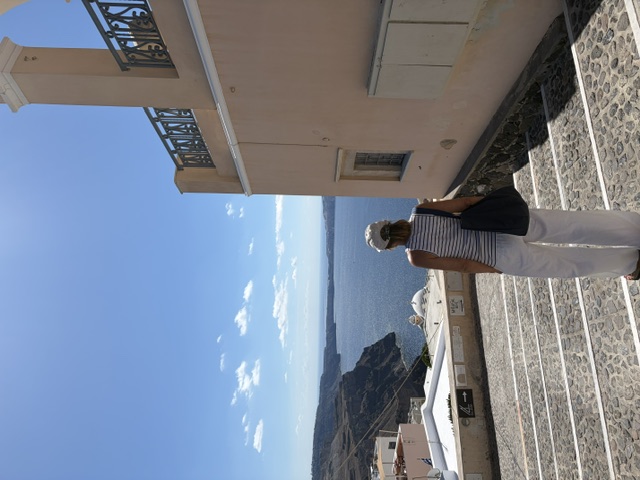
I’ve been back in Europe for a little over three months now after spending most of my adult life in the United States.
And something has become very clear to me.
Life feels different here.
Not perfect. Not stress-free. Europeans will certainly tell you they are busy, overwhelmed and burned out too.
But I have the unusual perspective of having lived both lives.
And from where I stand now, there is a rhythm here that I had almost forgotten.
Life feels a little slower. More cohesive. More connected.
People sit over coffee rather than carrying it everywhere. Meals are more often something you stop for rather than something squeezed between obligations. There is conversation. Walking. Smaller stores. Familiar faces. More moments that don't necessarily need to accomplish anything.
And it has made me think differently about a word we hear constantly in health and wellness today:
Longevity.
We are trying very hard to live longer
Longevity has become an industry.
We talk about supplements, biomarkers, biological age, glucose monitors, peptides, protein, fasting, cold plunges, red-light therapy and increasingly sophisticated ways to measure what is happening inside our bodies.
Some of this is fascinating. Some of it is genuinely valuable.
I believe deeply in prevention. I believe in maintaining muscle as we age. I believe in eating nourishing food, moving our bodies, sleeping well, protecting our metabolic health and understanding what our bodies need as they change.
That is a large part of the work I do.
But since returning to Europe, another question keeps coming into my mind:
If we are working this hard to add years to our lives, are we actually present for the years we already have?
Because there is another side of longevity that cannot be measured on a blood test or body-composition scan.
How rushed do you feel?
How often do you eat without really tasting your food?
How often are you physically with someone while mentally already moving on to the next thing?
When was the last time you allowed an ordinary moment to simply be enough?
Maybe health isn't something we need to optimize every minute
I see this even in the way we approach food.
In the United States, I became accustomed to turning packages around and studying labels: protein, sugar, fiber, ingredients, serving size, additives.
Here in Europe, I have noticed another small difference: systems such as Nutri-Score on many products can give you a quick, at-a-glance indication of the nutritional profile of a food.
Is it a perfect system? Of course not. No letter on the front of a package can replace understanding what you eat or looking at the overall quality of your diet.
But there is something appealing about making healthy choices feel a little simpler.
Because health shouldn't become another full-time job.
That thought extends far beyond food.
Your nervous system is part of your metabolic health too
We tend to separate these things.
Nutrition over here.
Exercise over there.
Sleep somewhere else.
Stress management when we have time for it.
But the body doesn't experience life in separate categories.
Your sleep influences your appetite and energy.
Your stress influences your behaviours and recovery.
Your muscle influences your metabolic health and your ability to remain independent.
Your relationships, environment and daily rhythms influence how you feel, and often the choices you make.
This is why I use the term Metabolic Synchronization in my coaching.
I am much less interested in helping someone follow another perfect health protocol than I am in helping her create a life in which the pieces begin working together.
Movement.
Muscle.
Food.
Sleep.
Stress.
Emotional regulation.
Relationships.
Purpose.
And yes "joy"
Because what exactly are we preserving our health for if we never give ourselves permission to enjoy being alive?
I know the temptation to postpone life
This is something I recognize in myself too.
There is always another milestone.
After I finish this project.
After I get the job.
After the business is more established.
After things settle down with the family.
After this stressful period is over.
Then I'll relax.
Then I'll travel.
Then I'll spend more time with people I love.
Then I'll take better care of myself.
Then I'll enjoy life.
But life has a rather inconvenient habit of happening while we are waiting for the calmer version of it to begin.
And perhaps that is one of the lessons coming back to Europe is teaching me.
Not to abandon ambition.
Not to stop caring about health.
Not to become passive.
But to leave a little more room for being instead of constantly doing.
Maybe this is part of longevity too
I still want strong muscles when I'm 80.
I want good metabolic health.
I want mobility, independence, cognitive health and energy.
I want to keep making the choices today that give my future self the best possible chance of having those things.
But I also don't want to reach 80 and realize that I spent decades preparing to live well someday.
There is a balance here that I think we are missing in many conversations about longevity.
The goal isn't simply more years.
It is more life within those years.
More strength, yes.
But also more dinners that last longer than expected.
More walks without checking the clock.
More conversations that don't have an agenda.
More laughter.
More connection.
More ordinary Tuesday afternoons that we actually notice.
Maybe ageing well isn't about defeating biology.
Maybe it's about supporting our biology well enough that we can remain fully engaged with our lives for as long as possible.
And perhaps one of the most powerful longevity practices costs absolutely nothing:
Be here for your own life.
So I'll leave you with the question I've been asking myself since coming back to Europe:
What are you saving for a calmer version of your life, and what would happen if you allowed yourself a little of it now?
Dominique Kohlenberger DK Wellness Blueprint Empowerment • Resilience • Equanimity Metabolic Synchronization — helping women come home to themselves again.